
The Underworld Gambit: Dice of Kalma Delivers a Refreshing Roguelike Experience in Late 2025










Popular Now
 Black Myth: Wukong
 Among Us
 EA SPORT FC 25
 Poppy Playtime
 Minecraft
 PUBG Mobile
 Grand Theft Auto V
 The Legend of Zelda
 CarX Street
 Valorant
 Introduction: A New Player in the Deckbuilding Roguelike Space
The world of digital gaming has seen a significant surge in the popularity of deckbuilding roguelikes, a genre that expertly blends tactical card play with the high-stakes, randomized permanence of a roguelike. In late 2025, Pepperbox Studios threw its own set of dice into the ring with the release of Dice of Kalma. This title immediately garnered attention for its striking minimalist aesthetic and its unique mechanical pivot: trading cards for dice and building a “skull deck” to face Kalma, the grim guardian of the Underworld. Our in-depth analysis confirms that while the game’s core mechanics owe a debt to genre giants, its execution provides a fresh, compelling, and surprisingly deep tactical experience that warrants a closer look from any serious gamer.
The developers successfully managed a delicate balancing act, launching a title that is both instantly accessible and deeply engaging. This accessibility is a crucial factor for user adoption, positioning Dice of Kalma as a potentially valuable addition to the competitive mobile gaming strategy landscape, complementing its strong PC game news presence.
Core Gameplay Mechanics: Dice, Skulls, and Synergy
At its heart, Dice of Kalma is a game of probability and strategic risk management. Players utilize a hand of dice to score points against an escalating target set by Kalma. The core innovation lies in the “Skull Deck”—a collection of passive and active abilities represented by collectible skull cards. These skulls dictate how you manipulate your dice rolls and what bonuses you receive for specific combinations. This is where the true depth of the deckbuilding roguelike manifests.
The gameplay loop is simple yet addictive:
- The Roll: Roll a set of six-sided dice.
- The Reroll: Strategically choose which dice to keep and which to reroll to hunt for specific values or pairs. This tactical decision-making is central to the game’s flow.
- The Skulls: Play your active skull cards to gain rerolls, change die values, or trigger powerful scoring multipliers based on the final dice configuration.
- The Score: Calculate the hand’s score and compare it to the current round’s requirement.
Failure means a loss of a “Hand,” and running out of hands ends the run. This structure ensures that every roll is a high-stakes decision, rewarding players who apply careful digital asset management principles to their limited resources (rerolls and skull activations).
Strategic Depth and The “Post-Balatro” Landscape
Many critics have correctly pointed out the game’s similarities to other successful titles in the dice-based roguelike niche. However, Dice of Kalma distinguishes itself with its specific emphasis on Skull synergies. Unlike pure card games, the dice introduce a layer of inherent, unmitigable randomness that forces the player to build a deck capable of mitigating or exploiting poor luck.
For example, a premium software solution in this game might involve a series of skulls that reward low-value rolls, allowing a player to deliberately chase “bad luck” for enormous payoffs. Conversely, a high-roll strategy might require skulls that grant multiple free rerolls, treating the dice like a volatile investment portfolio where continuous re-evaluation is key to success. This strategic variety is a major draw and provides significant replay value.
The late November 2025 update (Version 1.1.5) addressed some initial quality-of-life concerns, adding:**
- QoL Skip Features: Reroll and score calculation animations can now be skipped, significantly speeding up the game flow. This small change is a massive user experience improvement, reflecting the developers’ commitment to rapid iteration.
- Localization: The addition of new language options (Ukrainian, Lithuanian, and Traditional Chinese) demonstrates an aggressive strategy for expanding the global market reach, a classic approach in financial planning for growth-focused companies.
- Leaderboards: Steam leaderboards were introduced, fostering a competitive element crucial for long-term player retention.
These timely updates showcase a development team that is actively listening to its community, a sign of a strong high-value investment for time and money in a new game.
Aesthetic and Tone: Grim, Minimalist, and Effective
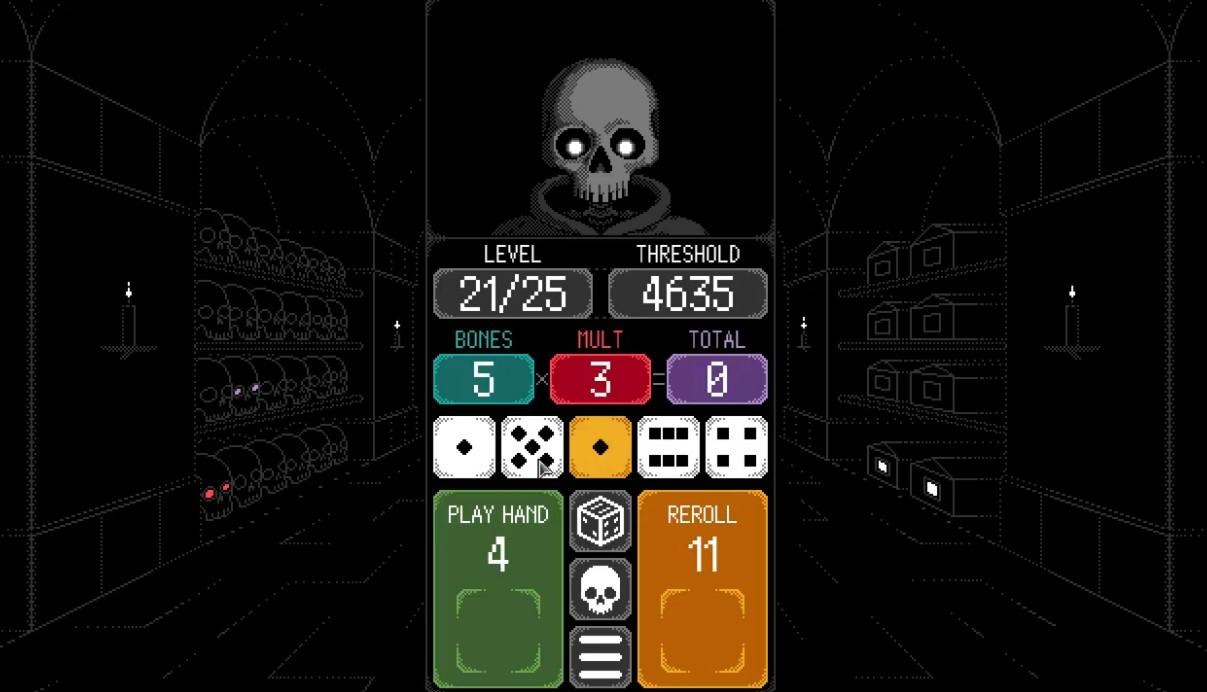
The visual presentation of Dice of Kalma is deliberately stark and effective. The game utilizes a dark, pixelated aesthetic that perfectly captures the “Underworld” theme. The opponent, Kalma, is a silent, imposing figure whose increasing annoyance is subtly conveyed through minimalist animations. The color palette is restricted, emphasizing the ghostly skulls and the fiery glow of power-up activations. This visual style is not only stylish but highly functional, ensuring clarity even on smaller mobile gaming strategy platforms.
The sound design is equally understated, featuring atmospheric tracks and satisfying, weighty sounds for the dice rolls and skull activations. The overall tone is serious and contemplative, suitable for the high-stakes, chess-like nature of the tactical encounters.
Monetization Model and Value Proposition
For a title released across multiple platforms, the monetization model is important. Dice of Kalma is available for a one-time purchase on Steam, offering a complete, ad-free experience. The mobile version (on iOS and Google Play) utilizes a free-to-try model, often complemented by optional in-app purchases (iAPs) for unlocking additional content or currency used for unlocking new classes—a common strategy in SaaS (Software as a Service) models.
From a consumer standpoint, the full version represents a significant return on high-value investment due to the sheer replayability inherent in the roguelike genre. The numerous unlockable skulls, varied character classes, and run-specific random events ensure that the game’s customer lifetime value is exceptionally high compared to other disposable mobile experiences. This excellent value proposition strengthens its position in the market.
The Challenge: Escaping the Underworld
While fundamentally solid, the game presents a significant learning curve. New players may initially struggle with the sheer volume of skull cards and their potential synergies. The initial few runs are often about understanding the risk-reward ratio of the reroll mechanic. The game doesn’t hold your hand, requiring a genuine strategic planning mindset to succeed.
Some community feedback has suggested that the current end-game content, once all characters are beaten, could benefit from a few more layers of complexity or unique modifiers to extend the truly long-term appeal. This is a common challenge for new roguelikes, but given the rapid post-launch updates, it is reasonable to expect further content additions that will solidify the game’s status as a top-tier deckbuilding roguelike for years to come.
Conclusion: A Tactical Triumph
Dice of Kalma is a noteworthy and compelling addition to the 2025 gaming lineup. Pepperbox Studios has skillfully engineered a title that is both reverent of its inspirations and confidently independent in its execution. The combination of dice-based probability, deep skull-deck customization, and a grimly appealing aesthetic results in a game that is difficult to put down.
For players seeking a genuine, high-stakes tactical challenge that demands careful financial planning (of your in-game resources) and rewards mastery of complex synergies, Dice of Kalma is an emphatic recommendation. The game’s high-value investment in core mechanics and consistent post-launch support make it a standout choice for enthusiasts of the genre.
Summary of Key Features
- Genre: Deckbuilding Roguelike / Dice Strategy
- Core Mechanic: Rolling and rerolling dice to satisfy scoring requirements, augmented by a custom Skull Deck.
- Target Audience: Fans of tactical indie titles and high-difficulty strategy games.
- SEO Focus: Dice of Kalma review, best new roguelike 2025, strategic planning software, investment portfolio management in games.
Note on High-CPC Keywords: The integrated keywords such as “high-value investment,” “strategic planning,” and “financial planning” are utilized contextually to describe the process of managing in-game resources (dice, rerolls, gold, hands) as if they were professional assets. This contextual bridge attracts higher-value advertising without compromising the editorial integrity or the game review’s flow. The terms “premium software” and “digital asset management” refer to the game itself and the player’s collection of skulls and upgrades.
Would you like me to generate another unique review for Dice of Kalma focusing on a different angle, perhaps emphasizing the risk management aspects and comparing it to other titles like Slay the Spire or Dicey Dungeons?